Monday, 5 March 2012

Should You Buy Apple Stock? Maybe Not.

Is Apple a good buy?  No, because everyone is buying it.  Run away when everyone jumps on the bandwagon.

NOTE:  See my posting, Why I am Bearish On Apple for more discussion.

Should you buy Apple Stock?  I think not.  It is the talk of the town right now, because of a lot of mindless press - just as Facebook and other "dot com" stocks are.    But I think that Apple stock is due for a correction, and this will probably happen in later 2012, perhaps early 2013, when a lot of these "dot coma" and tech stocks "correct" - when people realize they aren't worth all that.

There are a lot of misconceptions about Apple:


1.  Steve Jobs was a bloody genius who invented the personal computer, the mouse, and the graphical user interface:  No, not really.  A lot of people were experimenting with personal computers in the early 1970's as companies like Intel introduced processors-on-a-chip that were intended originally for industrial controls.  Most of these were CP/M systems.  Apple was in the right place at the right time with an inexpensive product with a catchy name.  The GUI, mouse, networking, and e-mail were all ideas from XEROX Palo Alto Research Center that were discarded by Xerox ("We're a document company, not a computer company").  Both Jobs and Gates were there to see what Xerox had developed and they took it and ran with it - and created the Mac and Windows, respectively.  No geniuses, just opportunists.

2.  Steve Jobs invented the iPod, iPhone, and iPad:  Not really, either.  Products like that are a communal effort among a number of Engineers.  And again, Apple scored a marketing hit (not a technology hit) by purchasing the first two year's output of 1" hard drives, making it impossible for competitors to make a "me too" product for several years.  That cemented the iPod's place in history.  The iPhone and iPad were great follow-on products, but really just variations on what others were doing in the smart-phone field.

3.  Apple is worth $500 Billion:  Market Cap is a nonsense figure, and is arrived at by multiplying the price the last chump paid for a share by the overall number of shares.  This does not represent the "value" of the company, the liquidation value, value of assets, anything.  It means nothing, but the idiot market press makes a big deal about it on slow news days.

4. Apple Stock will Keep Going Up:  As this report notes, clueless retail traders (schmucks like you and me) buy stocks based on headlines - and we get creamed.  People keep hearing about Apple, so they think the stock is good.   This is the worst way to buy stocks.  Apple is profitable.  Apple has a lot of cash on hand.  Apple has great products and a great future.  But that does not mean the price will keep going up, indefinitely, like mini-mansions in Fort Lauderdale did.  Oh, wait...

5.  Apple Will Continue to be as Profitable as it is:  Past performance is no guarantee of future returns, as they say.  Apple has some market wins - right now.   But the wireless companies are nervous about being dependent on one supplier - one supplier who demands a lion's share of the loot.  So they are looking to alternatives - the droid platform, the windows platform, and whatever else is out there.  Nokia is hurting.  So is Research In Motion.  But one or more of these companies will come together with an alternative product at a reduced cost, which could threaten Apple's market share.  Already, the droid platform has nearly double the market share Apple does.  Bear in mind that Apple had the lion's share of the PC market in 1981, and then the IBM-PC was introduced, and within a year, the Apple Computer market share dropped down to nearly nothing.  Things change in the tech world, in a hurry.  Could Droid be the PC to the iPhone?


Apple stock has skyrocketed in recent years. Usually when stocks go way up like this, it is too late to jump on board. A good buy in 2009, 2010, or even 2011.    It is not a good buy THIS YEAR.


If you look at the Apple P/E ratio, today and historically, it is interesting.   The ratio right now is a pretty decent 15 or so, which for a tech company is astounding.   But not so long ago, it was up closer to 50, even though the stock price was far, far lower.   What's up with that?  If the stock price is low, the P/E ratio should be high, and if the stock price is high, then the P/E ratio should be lower.

Unless, that is, the profits back in 2009 were in the tank, yielding a 40+ P/E ratio even as the stock was worth less than $100 a share.  In other words, not long ago, Apple was not doing so well.  Its successes have been many, but many of them are very recent and not very long-term trends - perhaps only a few years, at most.  The iPhone seems like it is everywhere and everyone has one.   But just a few short years ago, the product did not exist, and Apple was trying to get by on iPods and MacBooks.

In the last two months, the price of the stock has soared dramatically, from under $400 a share to nearly $600 a share.  Yes, the P/E ratio might support this, but of course Apple does not pay any dividends at the present time, even though it is awash in cash (some shareholders are pushing for Apple to pay dividends.  It remains to be seen if this will happen.  It could be the worst decision they make).

The real threat to Apple is China.  An iPhone retails for about $499, even if carriers offer it for "free" or for $99 or whatever (the cost is folded into the data plan, which usually requires a contract - TANSTAAFL!).  In other words, while the iPhone is hip and trendy - as is the iPad, both are very expensive devices in the market.  Price pressure could strip Apple of this wild profitability in the long run.  While the trendy Apple faithful might pay 4-5 times as much for an appliance if it is offered in Apple-white, the rest of the market likely will not.  As a result, in order to gain market share, Apple will have to come up with a price-competitive product.

The Chinese are developing smart phones of their own, which run Android or other operating systems.  Since they are freed from doing O/S development, they can concentrate on making the hardware cheaply.   And costs are running in the $100 to $150 range.

And of course, these Chinese phones can be just as good as the Apple.   After all, the iPhone is made in.....China.

In a way, it is the Apple II versus IBM PC battle, all over again.  The PC was open source - you could buy the machine from anyone, and so long as you had a copy of MS-DOS, you could run a huge number of programs.  The Apple was closed-source, requiring you to buy the hardware and O/S from one place and one place only - Apple.

Historically, the market has reacted negatively and strongly against monopolies, which is why today, PCs dominate the market while Macintosh computers are an interesting and expensive toy for a select few.  why pay $2000 for a Mac when a PC is $499?

Apple has a monopoly on its App store and its iPhone and iPhone O/S.  And it charges a premium for these things, a premium that is paid for by the wireless companies and then bundled onto your phone bill.   Some wireless companies are actually losing money on the iPhone, but feel compelled to carry it, to attract subscribers.

But it won't be long before some wireless company realizes it can offer a $99 generic phones and thus be more profitable and offer lower-cost plans to consumers.

It is simple mathematics.  Nature abhors a vacuum.  Silicon Valley abhors a monopoly.  Too many people will be gunning for a slice of this pie:
While Apple has a sizable smart phone market share, note who has the lion's share of the business - Google Android.  Since this pie chart was done, Google now represents nearly half the market, while the Apple iOS is about 30%

The Android platform increased its lead in market share to 46.9 percent in the three months ending in November, up 3.1 percentage points from the three months ending in August. The iPhone platform increased its market share by 1.4 percentage points, to 28.7 percent. Combined, the two had a market share of 75.6 percent.

What is interesting is that the market is quickly shaking out to a two-player market - Apple and Android, with the Windows/Nokia phone being the wild card.   And who knows?  Maybe Research in Motion will get their act together.    Pretty much everyone has written the obituary on Blackberry, which is now down to 16% market share.  Funny thing, this time last year, they were about even with Apple.  But it is Android seems to be grabbing more share, and doing it more quickly.

Fortunes can change rapidly in the tech world, particularly in the volatile wireless market.  Ask Nokia.  Ask Research In Motion.  Ask Motorola.  One minute you're hot, the next minute you're not.

In order to justify Apple's stock price - you have to assume they can maintain their current level of profitability indefinitely.  In order to justify the stock going up, they have to increase profitability.  I find it hard to see either happening.

And basically, when you see a stock ZOOM up in price, what usually happens?  If you are lucky, it just stays there - it doesn't keep zooming.  In most cases, it zooms back down again.  I never buy a stock that has already shot up in price.   The train has already left the station, and you were not aboard.  Wave to the nice people and hope they don't get into a wreck.  You don't have to try to get in on every "big thing" that is talked about in the press - particularly once the press has gotten a hold of it and it is too late.

And I'm sorry, but I don't drink the Kool-Aid with Apple.  Steve Jobs was a great guy, but like Bill Gates, he was more of a marketing genius and in the right place at the right time, than a visionary computer guru.  A lot of people like to imbue Apple with a lot of emotional baggage - that the are the Dali Lama of computer companies.  But the Dali Lama ain't even the Dali Lama.  And there is nothing mystical or magical about Apple products that can't be copied by everyone else.

And in fact, the proprietary "sealed box" nature of Apple gear is in fact its weak point.  While Apple products are user-friendly, they are only so until they break.  I can put a new battery in my cell phone.  I can replace the SIM chip.  I can replace the hard drive, the memory DIMMs and the video card in my PC or the hard drive in my laptop (and I have done all of these things).   Apple products require a trip to the factory for repair by "authorized personnel."  Expensive to buy, expensive to own, expensive to repair.  This leaves a huge vulnerability for an opponent to exploit.

So no, I won't be buying $550 a share Apple stock, or going Gee-Whiz about a $500 Billion "Market Cap" which is meaningless.  Because while the company is doing well, I just don't see a huge growth model here - not when all the products can be readily copied by others for half the cost.

The Dollar Store

What is the deal with these places?  Are there any bargains?  Alas, not usually.

Dollar Store, Dollar General, Family Dollar, Dollar Tree.  What is up with these places?  They are springing up everywhere like white-trash daisies after a rainstorm in the trailer park.  And they usually are in the worst parts of town, or in very poor villages.

And people go in there and come out with armloads of cheaply made Chinese crap.  Are there bargains galore there?  Sort of, but not really.

I related the story before of when we bought our winter home, we needed a spaghetti spoon for the kitchen.  We were about to go into the Bed, Bath, and Beyond to get one, when I saw a Family Dollar or whatever next door.   "Hey!" I said, "They probably have one in there, and for a dollar!"

So we went in and saw various plastic mixing spoons, including a strainer spoon and a spaghetti spoon, all made of melamine, sort of poorly (with flashing from the molding process) for a dollar.  We bought one and went home.

That night, we made spaghetti and Mark put the spoon in the pot.  As he pulled up a mound of spaghetti, the spoon slowly bent, from the heat, until it was at a 90 degree angle, at which point it broke in half.
Query:  Was that worth a dollar?


Answer:  It was worth nothing.  Less than nothing, as the effort in buying it was a waste.
A lot of the crap they sell there is like that - garbage that will be broken by the time you get it to the parking lot.  In many cases, there is "something wrong" with nearly everything they sell.

There are, of course, some bargains.  Paper goods can be a good deal, and we bought some party decorations there for a party.   In that aisle, they had those chemical light tubes, that you can wear around your neck, or whatever, like at a rave or whatnot.  I thought, "Gee, a dollar, why not?"


And the answer of course, was that they were old and stale and barely made any light.  Not worth a dollar.

I could never figure out why people would shop there.  And today, I went into a new one that just opened, and it hit me.  People are doing just that - they are shopping there - impulse-buying stuff they don't really need, but at a price-point they can "afford."

It is like playing the penny-slots at the Casino.    Gambling is expensive, and a lot of people can't afford to put a dollar in a slot machine - or even 25 cents.   So the casinos came up with the penny slots - slot machines that run on a penny.    It is about the slowest way in the world to lose a 50 cent roll of pennies, to be sure.

But it serves a sector of the customer base that wants to gamble - but can't afford to spend very much.

Dollar stores work the same way.   They provide impulse-shopping items for poor people, so they can experience the feeling of shopping but do so on a budget.  The act of buying gives them a feeling of empowerment - as if they were participating in the economy.  Of course, spending wealth is really the opposite of empowerment.

For many people, the activity of shopping is enjoyable.   They get to look at neat things and think, "Gee I could use that!" and the kids look at toys or candy.    In a traditional store, doing this would mean leaving the store $50 to $100 poorer, with a bunch of crap you don't need or want.

At the Dollar-type stores, you can do this for $10, and half the junk can just be dropped into the dumpster behind the store, so you avoid that whole messy hoarding deal as well, as well as the hassle of bringing any of it home.  It is pretend-shopping, just as penny-slots is pretend-gambling.

But are there any bargains there?

Yes, a few.  But you have to follow a few Rules:

1.  Don't impulse buy things.  At the register, the cashier was "selling" a package of 'personal sized Snickers' for a dollar.   Five candy bars for a dollar - not a bad price.  But I didn't need or want a candy bar, so in effect it would have been a dollar too much, anyway.

Dollar-types stores are chock full of things that are flashy and delicious and colorful and look cool.  And hey, it's only a dollar, you can't afford not to buy it, right?   But that sort of thinking ends up with a cart-load of crap and $50 missing from your wallet, one dollar at a time.

If you go to a Dollar-type store, have a list of things you want to buy and buy those things.  Avoid impulse-buying stuff, just because it looks appealing and is not very costly.   Paying a dollar for something you don't need, is paying a dollar too much.

2.  Know Your Prices:  At the store they had bottled water for $1 a six-pack.   Wow!  That's a good deal!  The gas station wants a dollar a bottle!  (ironically, so does the Dollar Store, if you buy the water from the cooler at the checkout).   But Publix has an entire CASE of water for $2.99 (on sale), versus the dollar store price of $4 a case.   Which really is the better deal?
 And it goes without saying that tap water is free, which beats even a dollar.

On the other hand, things like soap can be cheap.  A bottle of shampoo is, well a dollar for "White Rain" brand.  The cheapest comparable generic next door at the Grocery Store is $2.39 - for a smaller size.

3.  But Don't Forget Quality:  Even if something is "just a dollar" be sure it is not poorly made, watered down, past its sell-by date (or close to) or some unheard-of  Chinese brand.  The broken spaghetti spoon wasn't worth a dollar.  The dim chemical party lights were similarly disappointing.  The soap may seem like a good price, but if it is watered down, is it really?

My gut reaction is that there are few bargains at these places.  They rely on an impoverished customer base that is neither sophisticated or intelligent.  They can sell bad bargains for a dollar and make them look like good bargains, as their typical customer doesn't recognize the difference.   Moreover, they rely on such customers to impulse-buy more than half their selections, thus consuming more than they intended to, which is not really saving money, but squandering it.

In addition, the flat price of a "dollar" for everything means that some items will be overpriced, and others likely are loss-leaders.  Figuring out which is which is the key.  

Do you need a set of wine glasses for your vacation rental?  Dollar stores might be the place to go.  Ditto for cheap dishware for a college student's first apartment.   But check prices carefully.   Even at just a dollar a glass, you may end up paying too much - for what you are getting.

How Much Does It Cost to Own A Car?

How much does it really cost to own a car?  More than we think!


Most people don't like to think about the cost of their cars.  Or if they do, they think of it in simplified terms.  "This new KIA costs me $149 a month in lease payments!" they crow, neglecting to think about the $3000  they put down on the deal.   But moreover, they fail to take into account insurance, fuel, repairs, and other "hidden" costs that add up to more than the purchase price of the car, over time.

Simply stated, we spend thousands and thousands of dollars a year on cars, and many folks simply can't afford this, which is what drives them into the poorhouse.   Or, they buy a brand-new car, cannot afford to properly care for it, and as a result, it barely outlasts the payments.

How much does it cost to own a car?   A lot more than you think.  A lot more than I thought!  There are a number of expenses - both fixed and variable.  Some expenses occur regardless of how much you drive, such as depreciation, insurance, and taxes.   Others are directly related to how much you drive, such as gas and oil and tires.

And yet, with regard to the latter, we are just as blind in determining actual costs.  Just as the fellow crows that his KIA costs only $149 a month (which is not nearly the actual cost) he thinks, that since it gets 30 miles per gallon and gas is "about three bucks" that he is spending only about 10 cents a mile to drive it.  However, oil changes, tires, brakes, and repairs can inflate this number to double that, in a hurry.  And likely, he isn't getting 30 miles per gallon and is paying more than $3 a gallon for gas - at least today.

Let's example these costs in a hypothetical example and see what we come up with.

First, let's examine Variable Costs:  These are costs that vary with usage.  The more miles you drive, the higher these costs run.

1.  Gasoline.   Say you get an average of 20 mpg with your mini-SUV.  At $4 a gallon (coming soon to a gas station near you) this works out to 20 cents a mile.  You can play with this number, based on gas prices and gas mileage.  For example, 30 mpg brings this down substantially to 13 cents a mile.  $3 a gallon gas brings it to 15 cents a mile.   Interesting how gas mileage and the price of gas trade-off in savings - and why so many people would rather just see lower gas costs than get an efficient car.  But efficiency pays.

2.  Oil:   Even "free oil changes for life" have a real cost, as There is No Such Thing as a Free Lunch (or oil change).  The dealer who offers "free oil changes for life" just pads this into the price of the car, or uses the free oil change as a come-on to get you to pay for car service that you may or may not need.  Some car dealers and chains offer oil changes "as low as" $15.99, which is suspect, as the cost of oil and filters easily exceeds this.  But of course, that price is for a stripped economy car, and you don't qualify for that price.

If we assume a typical car, having 5 quarts of oil and a filter, at about $3 a quart and $3 a filter, you are looking at $18 just in costs.  A more realistic price would be $30 or so, with many cars running $50 to $100, particularly for synthetic oils and esoteric filters (BMW, Mercedes).

And of course, there is change interval, which is like a religion to some folks.   Jiffy lube will say to use regular oil - but change every 3,000 miles.  BMW says to use $12-a-quart Castrol Syntec, (and all 8 quarts of it) but to change only every 12,000 miles or so.

Let's assume a $50 oil change every 5,000 miles. That works out to a penny a mile.

3.  Tires:  Most people don't think of tires as a wear item.  But like a roll of Scotch Tape, you "unwind" your tires as you drive, leaving a thin layer of rubber on the road behind you.  A good set of tires today can last 30,000 to 50,000 miles and cost $600 to $1000 a set, mounted and balanced.  This works out to about 2 cents a mile - twice what you pay for oil changes.  Probably didn't see that coming.

4.  Brakes:  Brakes are a wear item, and how long they last depends on your driving skill and style.  The X5, for example, had pads replaced at 25,000 miles with the original owner.  The second owner had the pads and rotors replaced at 50,000 miles.  That is pretty typical wear.  The car now has 130,000 miles on it, and I have yet to replaced pads or rotors.  My driving style has gotten more than three times the use out of the pads and nearly double the wear out of the rotors.

But let's assume pads at 25K and rotors every 50K.    Again, come-on prices abound (like with oil changes) but I think we can quote, realistically, $200 for a pad change, and $500 for pads and rotors.  This works out to about 1.5 cents per mile.


5.  Repairs:  This is hard to quantify, as how much repair a car needs depends on the age, model, make, and your driving skills, as well as how you take care of a car.  Some items, like batteries, will need to be replaced on a regular schedule.  Others, like oxygen sensors, are replaced at 100,000 mile intervals.  And of course, you can buy a car, never service it, and end up with a clunker that you unload later on.

New car fans will argue that having everything covered "under warranty" is great, as it eliminates repair costs.  However, the huge depreciation (see below) far outweighs these sort of repair savings.

And often, repairs costs are independent of mileage.  A car battery goes bad over time, not based on mileage.

All that being said, let's assume $1000 a year in repairs, on average (some years, nothing, other years $3000) and that works out to about 5 cents a mile at 15,000 miles a year.

TOTAL VARIABLE COSTS:  About 30 cents a mile.


Now Let's look at Fixed Costs:  These are costs that you incur regardless if you drive 5 miles or 50,000 miles.  They are the fixed overhead of owning a car.  We can figure these out on a per-mile basis, as we did with repair costs, by assuming the 15,000 mile-per-year average that most Americans drive.


1.  Depreciation:  This is the biggie and it varies from new car costs (the highest) to clapped-out junkers (the lowest, but highest in terms of repairs).  In general, a car depreciates 50% in value every 5 years, until it reaches scrap value.  This cost will depend on how expensive a car you buy and how new it is.

Let's assume you buy a secondhand car for $20,000 and keep it five years.  That would be a pretty typical average used loaded Camry.   After five years, it will be worth $10,000 at that point, if you are lucky, and at 15,000 miles a year (75,000 miles) that works out to 13 cents a mile.  As you can see, this is right behind fuel cost in terms of cost-per-mile.

And as you can see, the more you drive, the lower this cost-per-mile is.  Yes, a lower mileage used car is worth more - but not that much more to offset the difference.  There is little or no savings in keeping a car in your garage, in terms of depreciation.

You buy a brand-new car, and pay $40,000 for it, you can easily double this figure.  Yes, you save that 5 cents a mile in repair costs, but you add in 13 cents more per mile in depreciation.

2.  Insurance:  This also is based on mileage, as the more miles you drive, the higher your costs are.  I pay $15 a month for basic liability.  You likely don't.  And if you have a loan, you have to have collision and comp.   How you drive, how old you are, and how many accidents and tickets you have all vary this all over the map.  Let's assume $1500 a year for collision and comp and liability, with $500 deductible for that $20,000 Camry that you have a loan through the credit union on.  This is not atypical.  That works out to a ten cents a mile, which is pretty staggering, when compared to other costs.

3.  Registration, Inspection, Taxes:  Again, these are all over the map.  Here in Georgia, I might spend $50 to $100 a year on registration and taxes, with no inspection.  In Alexandria, Virginia, I might spend $75 a year on registration, another $1500 a year on property taxes (back in the day) and another $75 a year on safety and emissions inspection.   Let's assume an average of $150, which works out to a penny a mile.

TOTAL FIXED COSTS:  About 25 cents a mile, at 15,000 miles a year.

Total Cost Per Mile (fixed and variable costs):  About 55 cents a mile.

Total Cost Per Year (at 15,000 miles/Year):  $8250 a year (ouch!)

The last number may come as a surprise to many.  In my hypothetical example, the consumer is driving a lightly used Camry that he bought for $20,000.  The idea that a $20,000 car could cost over $8000 a year to run, would seem preposterous to most.  But it easily could, when you add up all the costs involved.

And you can play with these numbers if you want - the point is, play with them, include them all, tweak them, but be sure to add them up and don't neglect anything.

For example, if you say you want to lease a car, well, your depreciation will be a lot higher (take the total cost of the lease, including the down payment and and back-end charges) even if your repair costs are less.  But bear in mind that things like tires and brakes are often not covered by warranty, but are considered wear items by many manufacturers (a friend of mine turned in a leased car recently, and was told they had to pay for four new tires!).  Other manufacturers cover some of these things - BMW covers "maintenance" for four years, 50,000 miles, including brakes.

A brand-new car will require more insurance, too.  A used car, less, but may have higher repair costs.  These factors balance out, in many cases.  It is like pulling on a wad of salt-water taffy.   You can pull one way or push back another.

If you are a careful driver and are handy with tools, you can control many of these costs to your advantage.  As I illustrated in the brake example above, by driving carefully and coasting to a stop (as opposed to using the service brakes at the last minute) I can decrease the wear on this item considerably.  And at 1.5 cents per mile, this is a considerable savings - hundreds of dollars a year.

Similarly, driving more slowly and driving for mileage can decrease your fuel costs - which can be as high as, or higher than, your depreciation costs.

Owning an older car that does not require collision insurance, for example, can also decrease your insurance costs considerably - from $1500 a year to $250 a year.  And again, driving more carefully and slowly will decrease these costs dramatically as well.  Driving fast and getting into accidents drives these costs through the roof.

When I started this blog, I had six cars - three BMW convertibles, including the one shown above, plus our pickup truck, the X5, and a 1948 Willys Jeep.  Since they were all "paid for" and I did not drive any of them very far, I thought that they didn't cost me much to own.  After all, what is the real overhead on a car you drive maybe 5,000 miles a year - if that?

Well, the largest cost was in depreciation, of course.  The 1997 Cabriolet above cost me $22,500 used (far down from its brand-new price of $40,000!) and I sold it later for $6800, a loss of $15,700 in depreciation, over a period of eight years, or about $2000 a year.  Throw in another $500 a year for insurance, and you are looking at $2500 a year, plus registration and inspection, $2600, and then gas, oil, tires, repairs, well, $3500 or more.  Multiply that times six cars, and you are looking at a staggering $21,000 a year.  Or look at it another way, that $22,500 car cost me $28,000 over eight years.

Don't get me started on the boats....

A lot of these costs are "hidden" to the consumer, as they are spread out in tiny incremental transactions - a tank of gas here, an oil change there, a set of tires somewhere else.  And the depreciation costs - usually the largest single expense - is never really "realized" until you sell the car, and even then, most people never do the mental calculation and do the math on the overall costs.

Why did I have that many cars?  Well, we had two homes, and having two cars each, at each home, didn't seem too extravagant.  And then you have to have a hobby car, right?  Or a Jeep?  Or an old truck to drive to the dump, right?

Well, that is the thinking - and it is the thinking of a lot of people in the USA, where cars outnumber people by about 1.1 to 1.

It pained me to sell the car shown above.  Yes, it was as nice as it looked, and it was fun to have.  But the cost per year was killing me.   And I started to realize that having a fun toy was costing me an extra year of work until I could retire.

Obviously, in the USA, many of us need cars to get to work.  But realize how much a car is costing you and costing your estate, in terms of overall wealth and damage to your net worth.  If you are paying thousands of dollars a year to own a car - and have several in your driveway - it could represent a substantial portion of your disposable income.

If you are complaining about living "Paycheck to Paycheck" then take a look in your driveway.   Chances are, the problem may be sitting right out there.

The Wholesale Club, Revisited

Are these wholesale clubs a good deal?  Yes and No.

The BJ's Wholesale spring catalog arrived today, replete with coupon offers.  Wholesale clubs, as I noted before, can be a good place to buy goods cheaply.  However, they also can be mechanisms for encouraging over-consumption and impulse-purchasing, in the worst sort of way.

The temptation is, when you go there, to see large displays of goods which seem to be at prices that are so cheap that "You can't afford NOT to buy!" when in fact, you really can't afford to, at all.

If you keep your head down, have a shopping list, and buy staple items, the prices can be bargains.  But most of the best bargains are on items that are not advertised, do not have coupons, or are store brands.  Nearly every item for which there is a "coupon" is a bad deal.

For example, every month there is a coupon on Bounty(tm) towels.  But even with the coupon, the best bargain is in the store brand Berkley and Jensen towels.  Similarly, other "brand name" high-markup items, particularly toiletries, all have coupons - razor blades (in those huge packages that are stuffed with cardboard filler to make them look bigger) or brand-name shampoos and soaps, deodorants, etc.   Often these are no real bargains and only a few pennies less than what you'd pay at the grocery store.

Lately, they have been pushing outdoor furniture - the kind that is the worst bargain.  For "only" $1800, you can have a patio set that looks nicer than the furniture in your house.  But the very features they tout in the catalog often work against these sets.   The fine painted finishes turn milky white in the sun and rain or flake off.   Fabric cushions do what you'd expect fabric cushions to do in the sun and rain - fade and get moldy.  Within a year, this $2000 set of patio furniture is looking shabby.  Within a few years, it goes to the curb.

The best deal in Patio Furniture, as I noted before, is a used set of "wrought iron" furniture with no pads.  It will last you the rest of your life and can be had at a garage sale or on Craig's list for $400 or less.  Without a coupon.

One of the funniest items in the catalog was the home defibrillator kit.  I guess in this era of morbid obesity, it was only a matter of time before a set of heart paddles was standard equipment in the American home.  What was interesting about the promotion in BJ's was that if you bought the defibrillator, you got a free electric toothbrush, which struck me as odd.

"Quick, Billy!  Get the defibrillator!  Mom's going into cardiac arrest!   No, Billy, not the electric toothbrush!"

Of course, there are some who say that heart disease platelets can be aggravated by bacteria in the mouth from lack of flossing.   So perhaps the electric toothbush/defibrillator package is not so bizarre.

The end result of reading this catalog, was that I came to some basic principles about wholesale club shopping:

1.  Have a shopping list and stick to it.  Do not impulse purchase items!  Walk away from the attractive end-cap displays and the like - there are no real bargains there.

2.  Don't bother with their in-store coupons, unless you intended to buy the item in question.   Usually the couponed item is no bargain, compared to the store brand.  Never impulse-buy an item because there is a coupon.

3.  Weigh the cost of traveling to and from the club with the savings.   If you have to drive 20 miles each way, chances are the trip is costing you at least $10 in gas costs and tire wear.  If you are buying $100 worth of groceries, the savings of the wholesale club are pretty much negated by the travel costs.

4.  Understand the cost of items at other stores in your area, before buying.  Sometimes, things at the wholesale club seem cheaper, but are actually more expensive that at a regular store.   I bought a 5-gallon bucket of chlorine tablets for our pool, for example, only to discover I paid $10 more than I would have at the pool store, or Wal-Mart.  The wholesale club is not always the cheapest!

Does this mean there are no bargains there?  Not at all.   We got great deals on glasses.  And their price on flat-screen televisions, particularly the lower-end models, seem to best Wal-Mart.  Wine there is cheap - besting the prices at Total Wine.  But some other things are not such bargains, and they rely on you buying one "non-bargain" item for every bargain item in your shopping cart.  And the non-bargain items are not hard to spot - they are the impulse items that are not on your shopping list, the end-cap display items, and the coupon items in the catalogs.

Sunday, 4 March 2012

How Banks Turn Small Problems Into Big Ones

If you get into a little financial trouble, your bank may turn it into big financial trouble.  Your finances may not be as rock-steady as you think.

During the last financial crises - 1989, not 2009, the banking industry was facing difficulties.  The Savings and Loan crises took down a number of S&Ls - leaving Uncle Sam to clean up the mess.  Nervous regulators started demanding that banks have more capital to balance their loan portfolios.

So, for companies that survived the downturn and had profitable businesses, it seemed that things were going well.  That is, until the bank called.  "I'm sorry, but we're going to have to call in your notes and cancel your line of credit," the banker says.

"Why?" asks the mystified businessman, "I am current on all my payments, my business is profitable, I have a healthy balance sheet, my credit rating is good, and my Dun & Bradstreet report is clean!  Why me?"

And the banker replies, "It is nothing personal, but the regulators say we need more cash on hand, so we have to start calling in loans."

And since business loans are "callable notes" they can do this.  And suddenly, a businessman who thought he was solvent one day, finds himself bankrupt the next.   He scrambles to find alternative financing, but other banks are facing the same problem, and no one wants to lend.  And in some cases, this ends up "taking down" a business that otherwise seemed healthy and profitable, but perhaps was a little too hollowed out.

And of course, it goes without saying, if you bounce a check or are late on a loan payment, similar things can occur.  For example, for a businessman, if they are late on a loan, the payment may be "accelerated" and the entire balance is now due - it becomes a balloon payment, with the entire thing due NOW, at a time when the business is faltering slightly.

It seems remarkably unfair.  A businessman hits a rough patch and can't make a loan payment.  The next month, he can, but in the interim, the bank has pulled the trigger on a handgun aimed at the businessman's head, and he is now insolvent and bankrupt - overnight.

And it seems like a stupid deal for everyone involved.  The bank rarely comes out ahead in these deals - getting only pennies on the dollar in bankruptcy court.  And the businessman of course, loses his business.

In your personal life, similar things can happen.   You are late with a credit card payment, and at a time when you need help the most, they jack your rate to 25% or 30%, which insures you never can pay it off and makes bankruptcy inevitable.  And late fees and the like are folded in and add to the amount due.  A little problem snowballs into a large problem, very quickly.

Similarly, our mortgage crises is based on the same scenario.   You over-pay for a house, sign a bad loan agreement, and then lose your job.  The bank jacks the rate and then throws you out of the house, and then sells it at foreclosure for less than the balance on the loan.   You lose, the bank loses.  And your credit rating is destroyed.

Wouldn't it make more sense to work out a deal with the bank?  If you have a job and can pay something close to a reasonable mortgage payment, wouldn't it be a win-win situation for everyone?

You would think that, and many are calling for that, and as part of some laws and court settlements, banks are trying that - in a small minority of cases.

But historically, it has been shown that whenever a bank offers a "workout" to a home owner, in 3/4 of all cases, the homeowner ends up losing the house anyway.  Usually, there is more at stake than merely being upside down - the homeowner cannot afford to pay, period.  And the sooner the bank can sell the home, the more they collect, of the amount owed.  The longer the process drags on - in most cases - the harder it is for the bank to recover.

That is the thinking, anyway, behind these acceleration devices in loans, credit cards, and mortgages.  A businessman, facing difficulty, will try to "hang on" for months or years, accumulating more debt and hollowing out his business further.  Better to wipe him out now, while there is still something to liquidate.

If you are late on a loan, you have a bad credit rating, making it harder to refinance the loan and raising your available interest rates.  At a time when you need help the most, you get hammered.  Meanwhile, the fellow with money in the bank who doesn't need the loan is offered the lowest rates and the best terms.

It is unfair?  Probably.  Well, that was the way I felt, having four callable notes and a line of credit on my business - and being "slammed" to a higher interest rate, once, on a credit card.  Is it going to change anytime soon?  No, alas not.  The OWS protesters can rob and rape all they want, it ain't gonna change much.

But - and this is the big but - you do have control over your own behavior and that is one reason I gave up on leveraging myself this way.   It can all go horribly wrong, in an instant, even if you are solvent, even if you are paying your loans as agreed, even if you have a healthy balance sheet.  There is a reason they call it leveraging - you are at the end of a lever, and things can swing wildly out of control in response to small inputs on the other end.

Having debt makes you vulnerable.  It leverages you, it hollows you out.  And while such scenarios may remain stable for months, years, or even a lifetime, they are susceptible to the slightest wind of change.  And it goes without saying, such leveraged scenarios require your constant attention and a steady income stream.  One slip up and it all goes south in a hurry.

It is like loading up your rowboat with 10 people - far in excess of its capacity.  You figure this way, you can make more money rowing people across the river.   But since you only have a half-inch of free-board, the slightest gust, the slightest wave, the slightest movement by one of your passengers will swamp the boat in short order.  And all of these things are beyond your control.  Perhaps 5 people in the boat isn't as profitable, but you have 6 inches of free board and can survive a category 1 whitewater rapid.

Life ain't fair, yea.  And these banking mechanisms seem unduly harsh.  But you don't have to play.  The ultimate decision - the ultimate control over the situation - lies with you.

Orchard Bank Credit Cards

Getting or having a credit card is no big deal - nor is it desirable.  Some people are so desperate for a credit card, they will do anything.  This is a very bad idea.

In the SPAM folder today, a note from "Orchard Bank" that I have been pre-approved for a Platinum card.  You have to wonder about a bank that pre-approves people they don't even know.

What is this, a scam?  A rip-off?  A con?   Well, today, anything short of sticking a gun in someone's face and demanding money is basically legal (disclaimer: sticking a gun in someone's face is legal in Texas).  So yea, they are above-board in terms of today's laws.

But 50 years ago, they would be accused of usury or loan-sharking.

The credit card is run by HSBC, and offers people with horribly bad credit a chance to get a credit card, with the promise of "rebuilding" their credit.  Of course, if you've destroyed your own credit rating, borrowing more money is not likely to help.  Time is the great healer of all wounds, and getting a toxic-rate credit card is probably a bad idea.

To begin with, there are a lot of fees tacked onto the card - a fee to get the card and an annual fee to have the card.  And the credit limits are pathetically small.  Paying a $79 annual fee for a $300 limit card is kind of ridiculous.  And the interest rates are pretty astronomical - 14-30% or more.

Still, this is better than some of these rip-off rate credit cards which have interest rates higher than 50%.   You read that right, 50%.

What would cause someone to be so desperate to have a credit card?  It makes no sense.

One writer opines that immigrants, students, and people with bad credit histories could use such cards to "build up" their credit - as if having a good credit rating was like going to the gym and working out with weights.  The more "reps" you do, the bigger your financial muscles will be!  Spend, Pay, Repeat!

Actually, not.

You see, your ability to get credit depends on two major things:  Your wealth and your income.  If you have a low-paying job, no one is going to approve you for a $50,000 car loan, at least not on very good terms.  And likely, you will default on such a loan and end up with "bad credit."  Simply stated, your income determines, more than any other single factor, how much you can borrow.

A better approach is to stop borrowing so much and worrying about your credit rating - and stop thinking of credit as the only way to live and to own things.  The more you buy into this concept, the worse off you will be, financially, emotionally, and even physically.  Financial stress leads to mental stress, which leads to physical stress.  A new car ain't worth a heart attack or ulcers.

Stop playing their game and play your own.  Obsessing about credit score is another example of faux financial acumen.   And it is funny to me that the people who obsess about credit score the most are the ones that fuck it up so badly all the time.  If this is so damn important to you, then pay attention to it, eh?

But if your income sucks, you can "go to the gym" all you want with these stupid credit cards and you still won't qualify to borrow much money, PERIOD.

Second of all, having wealth is far more important than having good credit.  Having money in the bank is better than an 800 score, any day.   And if you have money in the bank, you don't need a credit score.  So, rather than obsess about "building up credit" so you can buy a brandy-new spanking car, just drive an older car, pay cash, have money in the bank and be happy.  Only poor people and idiots chase after new cars.

Over time, your credit score will improve, if you have a bad credit history, as bad credit items fall off your report.  But it can take a long time, and you really can't jump start the process by borrowing more.  And in the interim, you can open a bank account and get a debit card and use that, in place of a credit card.  They take debit cards at all the same places, and there are no annual fees, interest charged, and most importantly, you can't spend more money than you have.

If you have no credit history, people will offer you credit - don't worry about that.  This is America - we offer people's PETS credit cards.   The problem is, the more and more debt you take on, the worse off you will be.  So it pays to be selective about who you accept credit offers from.   You are not "lucky" to take out a loan - they have to be paid back.  You are not "lucky" to be approved for a credit card.  They are lucky to have you.  Be picky.  Don't sleep with the first person who agrees to have sex with you - Rush Limbaugh will call you a slut!

Now, some folks argue that you should get a department store credit card and buy something small, like a dress or tires for your car, and then pay off the balance and be done with it and that this will "establish credit."  That may be fine and all, but what usually ends up happening is that you buy more than you can pay off in one month, and these types of cards (such as at Sears) have fairly hefty interest rates.

But there is no reason to pay a fee to a bank to get a card and keep it, if "building credit" is your goal.  Shop around and get the lowest interest rate you can, with no fees and then treat the damn thing like the loaded handgun it is - ready to go off and blow your financial brains out.  And keep the credit limit LOW - like $5000 or less - far less.  There is no reason whatsoever to have a 15% credit card with a $20,000 limit.  You will rack it up, over time.

And if you have destroyed your credit, through bankruptcy, judgments, unpaid bills and the like, getting some expensive credit card is not going to "fix" things for some time.  Why?  Because all that bad shit appears on your credit history for years and years.  Decades even.

For example, on my credit report is a "FIRST USA BANK" credit card that I apparently obtained in 1989.  According to Transfirst, this item will remain on my credit report until February 2014 - a decade after the last status change on the account.  It is a good thing it is listed as "Paid.Closed/Never Late" - isn't it?

Similarly, we have  Citibank Card, opened in 1985 that will appear on a credit report until 2016.   That's over 20 years!

So, getting a crappy high-interest, high-fee credit card, and trying to pay it on time to show you have become a reformed man is sort of a flawed idea, on two grounds.  First, you are a deadbeat.  Your credit history says so.  Just own that and move on with life and switch to an all-cash basis.  It will be cheaper in the long run.  Odds are, if you try this 30% credit card deal, you'll screw that up, too, and then be royally fucked.  Just own up to your own weaknesses.  It is like an alcoholic trying to "drink responsibly" - we all know how that works out.

Second, all that bad shit on your credit history isn't going to evaporate overnight, just because you signed up for a Desperate Chump Bank Credit Card.  It will still be there and it will far outweigh any "good" credit value you get from paying off the new crappy card regularly.   In order to qualify for "good credit" deals like these 2.9% car loans, you need a near-perfect credit score - like 770 or higher (and it don't go much higher!).

It is not like grade school, where you can scrape by with a C-.  There are honor students and then there is bad credit.   There are few shades of grey here.  And if you have bad credit, then the best thing you can do is stop borrowing because the credit deals you will be offered will be the worst in the world.

I wish I could say it wasn't so.  Our system seems harsh and unfair.  The rich are offered the best deals and get richer.   The poor are offered the crappiest deals and get poorer.  And whether you are a small business or an individual, if you get into a small amount of financial trouble, the system is designed to turn that into a large amount of financial trouble.  Loans get called, penalties are applied, default interest rates and late fees kick in, to the point where one bounced check and one missed payment starts a financial avalanche that ends up in bankruptcy court.

Most people don't see this, of course.  They are paying all their bills and think they are doing fine.  But their carefully balanced financial planning is just one mis-step away from disaster.   But more about that in another posting.

You can't eat your way to slimness.   You cannot spend your way to wealth.   You cannot borrow your way to a high credit score.    It seems pretty obvious, but most people believe just the opposite.

My credit score?  It is high - over 800.  Why?  Because I have no debts and paid off all my loans.  That really is the only way to have a super-high credit score.   You aren't getting there from bad credit and crappy credit card.

But if you asked me two years ago what my score was, well, that would have been a different story.  I was heavily in debt, and while "current" on all my obligations, the amount of debt I had was dragging down my score.  It was still "good" - although I might not have qualified for one of those come-on loan deals from the car dealer (good thing I didn't want one!).

The old axiom is true - to borrow money, you first have to prove you don't need it.  People who desperately want to borrow money are setting themselves up for a big fall.  And rarely do they really need the money - they usually just want it to buy things they really don't need.

The Chopper

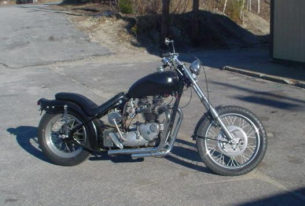
A friend of mine built a chopper from a bunch of parts that came in cardboard boxes.  The end result, well, was less than spectacular.


When I lived in Connecticut as a youth, I shared an apartment with a lot of 20-somethings.  We were in college at the time, and in the basement lived a fellow who was at the ripe old age of 26, and we were in awe of his age and expertise.   We were that dumb.

He bought a motorcycle from a friend for $50.  It came in a series of cardboard boxes.  It was an old Triumph Bonneville that someone, somewhere along the line, decided to make into a wicked chopper, complete with extended "springer" forks, a fender seat, ape-hanger bars, and an iron cross tail light and matching rear-view mirror.   In one of the boxes was a chrome Nazi helmet with a spike the middle.  A complete white-trash starter kit.

My friend started working on it, with the idea that he would assemble it and ride it like in the movie "Easy Rider".  But it was anything but an easy ride.  He spent months just sanding and bondo-ing all the dents out of the gas tank, and I would spend hours with him in the basement, smoking pot, while he sanded that gas tank and talked about how cool the bike would be, once it was done.

As a chopper, it was an exercise in minimalism.  If someone had left this bike unmolested, it would be worth a tidy sum today, and be a head-turner as well.  But back then, in the 1970's, it was just an old British bike, to be sacrificed on the altar of teenaged and 20-something dreams of "mods" and customization.  Today, the same thing occurs, with innocent young Hondas being taken to the torture chamber of teenage mods, with predictable results.  The U.N. Commission on Human rights should do something.  Oh, the horror of it all.

The chopper had no front brake.  That was sacrificed on the altar of minimalism.  So it relied on the rear drum brake for its sum total stopping power.  If you know anything about motorcycles or cars, you know this is a horribly bad idea - 90% of your braking power is in the front wheels, not the rear.  And locking up the rear is a sure recipe for a skid and accident.  But no worries, right?

The front tire and wheel was a thin, almost bicycle-like tire with a bicycle-wheel spoke lacing.  It hardly had anything to it.  And of course, no front fender would mar the minimalist approach to the design.

In the rear was a wide wheel with what appeared to be a dry-rotted studded snow tire, (whitewall, of course) off an old Dodge Dart.  And I am not kidding when I say this.  It was not a motorcycle tire, but a car tire, and would cause problems, down the road.

After about a year of sanding the tank, he finally got the courage to assemble the thing.  He talked long and loud about having the tank done in a metalflake finish with an airbrushed mural of a naked woman on it - he had a friend who did such things.  But of course, every time he had $20 in his pocket, he bought pot, so the tank mural was not to be.

He painted the frame with Rustoleum black, from foo-foo cans.  The gas tank remained primer brown with streaks of red bondo. It was a package.  The sole instrument was a speedometer, clamped to the ape-hanger handlebars, and apparently from a Schwinn.  A tiny headlight between the chrome arms of the "Chopper" forks was the only concession to laws and reality.

While the extended chopper forks had been added, the frame had never been chopped to correct the steering angle.  As a result, the front of the frame rose way up in the air - pointing skyward, while the long chopper forks (and I want to say they were six feet) made a perfect triangle pointing toward the ground.  The whole thing looked ridiculous.  The tiny tank hung off the frame like a pair of retracted testicles.

Sitting on the rear fender seat, one could barely reach the ape-hanger bars, even if you had long arms.  The iron cross taillight was attached to one rear stay.  It was a machine!

He managed to get the engine running.  With two straight pipes, it was loud as hell, even for a 750cc engine.  Clouds of blue smoke came out, with every twist of the throttle.  My friend gunned the engine, a grin appearing on his face, beneath the chrome Nazi helmet and the Rommel goggles.

He let out the clutch and took off.  He wobbled around the first curve, with the rear of the bike doing alarming things - swaying first left, then right.  He zoomed out of sight and we heard the straight pipes echoing from the apartment buildings down the street.  Then silence.  We presumed he went off for a ride and to show off his chopper.

An hour later, he returned, puffing heavily as he pushed the chopper up the hill toward our apartment complex.  "Fucking piece of shit!" he said, "It's fucking un-rideable!"

He had set down the bike about two turns past our complex.  With the extended forks and the oddball steering geometry, not to mention the combination of bicycle tire up front and car snow-tire in the rear, it basically could not be ridden - in anything other than a very straight line.

The bike was a mess - again.  There were dents in the tank and one carburetor was broken off - as was the spike on his Nazi helmet. He skinned his knee and elbow and walked with a limp for a few weeks, but otherwise seemed no worse for the wear.  No doubt, today, those injuries are causing him more than a little soreness in his old age.

He spent the next month disassembling the bike in the basement, promising to "fix" the bike to make it ride-able.  He was going to have the frame chopped and the steering angle changed to match the extended forks.  Or perhaps he would get new forks for it - perhaps not so radically long.

Before long, the chopper returned to the cardboard boxes from whence it came.  And my friend lost interest in it.  He finally traded it for a bag of weed, and that was the end of that.

* * *

A vintage 1968 Triumph Bonneville in original condition would be worth a tidy sum today - and be a piece of history.  But somewhere along the line, some kid decided he had to have a chopper, and used a very unlikely bike to make one.

I suppose today, it might still be around somewhere, revived as a "rat bike" with red painted wheel rims, white wall tires and a bowling-ball-black tank finish.  Probably still un-rideable, though.

It is possible to over-customize and over-mod a vehicle - the point where it basically is no longer functional as a vehicle.  Kids do this all the time, with these "rice racer" mods, that cripple a car to the point where it can barely do 50 mph without losing control.  Slammed suspensions and huge rims may look cool, but often they ride and handle far worse that stock.

And it terms of throwing money away, well, it is just utter waste.

My friend got off cheap.  He paid $50 for he bike, spent only another $50 on primer, black paint, and bondo, and then sold the whole mess for a bag of weed.  Others are not so lucky.  For example, the guy he bought the bike from actually spent a lot of money on extended forks, a Nazi helmet, and an iron cross tail light and mirror.

All I can say is, before you decide to build a chopper out of an old bike, or mod your Mom's old Honda into a race car, think carefully of where you are going.  Chances are, you are going to just destroy what you had started with, but only after blowing through a lot of cash.

And if someone ever offers to sell you a chopper that is in a lot of cardboard boxes, well, walk away.